
 How to resolve AdBlock issue?
 Same words, different outcome – why leadership ideas succeed or stall long before the first slide appears …
By Jeff Purser >>
ONE OF THE THINGS I’ve noticed throughout my career is that two smart leaders can walk into two different rooms carrying exactly the same idea, the same commercial opportunity, the same supporting data, and walk out with completely different outcomes.
In one room, the idea gains traction almost immediately. People lean in. Questions sharpen the thinking. Momentum builds and the conversation starts moving towards action. 
In the other, the same idea gets stuck in hesitation. More data is requested. Clarification is demanded. Energy drains from the room before the idea has any real chance to move.
For a long time, I watched leaders explain this away as politics, difficult stakeholders, or simply bad timing. But the more time I spent in sales, communications, negotiations, and leadership environments, the clearer something became.
Most ideas do not fail because they are weak. They fail because they arrive at the wrong emotional moment.
The wrong emotional moment
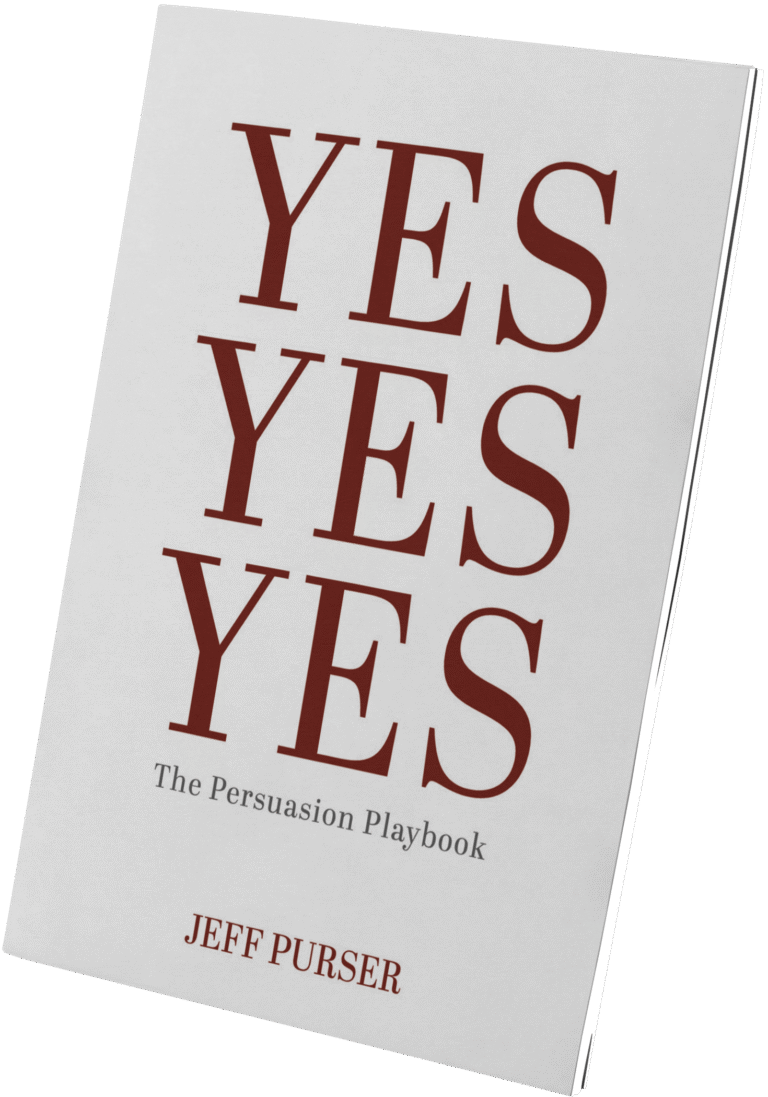
That insight became one of the foundations of my book, Yes Yes Yes: The Playbook of Persuasion, where I explore a simple idea: Influence begins well before the words.
In business, we spend enormous time refining the message, building the deck, strengthening the argument, and rehearsing delivery. Far fewer leaders stop to think about the emotional state of the room receiving that message.
What I’ve found is that every room has a pulse before the meeting even begins. You can feel it in the way people enter. The pace of side conversations. The distracted glance at a laptop. The executive who is physically present but mentally somewhere else. The tension no one acknowledges, but everyone can feel.
Most leaders rush straight past this because they are focused on presenting. They are prepared to speak, but not necessarily prepared to read the room. The strongest leaders understand something different. Attention has to settle before persuasion can begin.
In Yes Yes Yes, I describe this as the opening emotional movement, the moment where people are subconsciously deciding whether they trust the energy, the person, and the timing of what is about to happen.
That is why presence matters so much in leadership. Not presence in the performative sense. Not volume, charisma, or theatre. Presence as steadiness. Presence as control. Presence as emotional coherence.
People follow ‘certainty’ over ‘information’
I often say people rarely follow information first. They follow certainty.
This is where many capable executives unintentionally lose the room. They assume persuasion is about explaining more, proving more, or accelerating certainty through information. So, they move quickly into detail.
Slide after slide appears. More statistics. More complexity. More supporting material. But attention rarely deepens through overload. It deepens through relevance and curiosity.
Some of the most persuasive leaders I’ve observed understand the power of restraint. They know how to create space before filling it. A pause. A reframed problem. A sharp observation that makes the room think differently. Often that creates more engagement than 20 extra slides ever could.
Persuasion is not about overwhelming people with information. It is about sequencing moments so belief has somewhere to go.
Persuade through timing and emotional sequence
That idea sits at the centre of the framework I explore throughout Yes Yes Yes. Not that persuasion is manipulation, but that timing and emotional sequence shape how ideas are received.
Because, in practice, most business persuasion follows a recognisable pattern. First, attention has to rise. Then trust and alignment begin to form. Only then does commitment start to feel natural rather than forced.
Skip those stages and leaders often mistake resistance for disagreement, when in reality the room simply has not caught up emotionally.
I’ve become convinced this matters more than ever in modern business. Organisations move fast. Attention is fragmented. People are overloaded.
Leaders are expected to create alignment in increasingly noisy environments, often with less time and less patience from stakeholders. In that context, persuasion becomes less about hierarchy and more about precision.
The leaders who consistently create momentum are not always the loudest, most charismatic, or most forceful people in the room. More often, they are the ones with the strongest sense of timing.
They know when to slow the conversation down. When to let silence do some work.
When to create tension.
When to invite contribution.
And critically, when the room is actually ready to move.
Because leadership is not simply about delivering ideas clearly. It is about recognising the moment people are ready to believe them.
ABOUT THE AUTHOR
Jeff Purser is a communications strategist and commercial director with more than two decades of experience across sport, media and entertainment. His career includes senior roles connected to the Olympic Games, the South Sydney Rabbitohs and Optus Television. He has produced feature films including Fat Pizza and Cedar Boys and advised senior executives within major media organisations. He is the author of Yes Yes Yes: The Playbook of Persuasion, now available on Amazon. Turn to Research and Books for a preview of Yes Yes Yes: The Playbook of Persuasion.
ends