Digital Business

The digital business revolution and adapting to change - Traffika

ADAPTING to the disruption technology causes is never without some challenges. But with any challenge comes opportunity and Traffika Australia CEO Andrew Lane sees great opportunity for nimble business leaders to make well-informed headway simply by taking notice of one of the great benefits of digital disruption: their own data.

He said, in particular, the exponential increase in data collection and analysis was forming a new wave of the digital revolution, one that is transforming businesses, industries and economies of all sizes. 

“Change on this scale is often accompanied by fear, uncertainty, doubt, confusion and a daunting demand for new skills, resources and capital expenditure,” Mr Lane said.

“The world's largest companies are equipped to deal with this change as they have huge resources at their fingertips. But things look entirely different for many private and more modestly sized public companies.

“It is harder for them to find the money, time, people, skills and confidence needed to comprehensively explore, test and adopt new techniques and technologies.”

Mr Lane said the clear problem business leaders faced was the fact that the ‘Digital Business Revolution’ had already arrived, but not everyone is equipped to deal with it or even to participate.

“The question becomes, how do we close the gap between businesses who are able to participate and succeed in the digital revolution and those we aren’t?” Mr Lane said.

“Fundamentally there are only two things preventing the adoption of digitisation; barriers that stand in the way and the timeliness in which they are addressed.”

Mr Lane said the scale of Traffika’s extensive, global research had identified seven distinct barriers to digital success that, when overcome, would help build the thriving businesses and economies of the future.

“Our free Digital Success Profile is designed to help you identify which ones are preventing your business from participating in the Digital Business Revolution by assessing your online performance,” Mr Lane said.

A free report is available from Traffika through its website at  traffika.com.au/dsp.  

* Traffika is an industry expert member of Victorian Leaders, the organisation helping to mentor and connect the next generation of leading companies based in Victoria.

ends

Creativa’s video ‘personalisation’ leads lost Bulldogs back to the ‘kennel’

EXTRA >>

MELBOURNE-BASED creative agency, Creativa, has shown how clever personalisation of marketing – including personalised video – can deliver extraordinary results.

Creativa has won accolades for its campaign that used video capability – allowing the individual personalisation of content – to successfully help the Western Bulldogs AFL club drive lapsed members to sign up again. 

The Western Bulldogs asked creative agency MMR to develop a campaign that would encourage lapsed members to re-sign. The campaign, titled Lost Bulldogs, used personalised digital content to re-engage these former members.

MMR partnered with Creativa to develop a unique video, the hero of the campaign, and 10,000 individualised videos were sent to lapsed members.

“These dynamic videos used data from multiple sources to automatically create a highly personal experience for users,” Creativa director Damian Blumenkranc said.

The club’s member marketing campaign aimed to leverage content personalisation – targeting content to individuals based on who they are or where they are – and Creativa delivered a unique video platform to drive the campaign.

Mr Blumenkranc said the campaign sent members to a microsite, which allowed supporters to create a ‘Lost Bulldogs’ poster and personalised video for their friends, then share this content on social media and via email.

“The play button is one of the most compelling calls to action on the web and becomes even more powerful when combined with the fact that we as individuals crave personalised experiences,” Mr Blumenkranc said. 

Personalised videos are being used to great effect for superannuation statements, bills, quotes and client onboarding.

“During this campaign, over 700 custom videos were generated in real time.”

The Western Bulldogs recently announced they had reached 30,000 members, 5,300 members ahead of the same time last year, including the welcome return of ‘some old dogs to the kennel’.

“These numbers are exciting and prove that truly engaging content delivers results and helps achieve business objectives,” Mr Blumenkranc said. “It demonstrates that viewers don’t just want a story; they want their story and it suggests content personalisation has arrived in terms of usage, acceptance and effectiveness.”

Mr Blumenkranc believed 2016 would usher in a new era of personalised marketing, calling it ‘the year of personalisation’.

“And it certainly might be the year of the dog, given the goals the Western Bulldogs are kicking both on and off the field,” he said.

* Creativa is an executive member of Victorian Leaders, the organisation helping to mentor and connect the next generation of leading companies based in Victoria.

www.creativa.com.au/dynamic-videos


ends

Employee fitness app takes out 2016 Tanda Hackathon

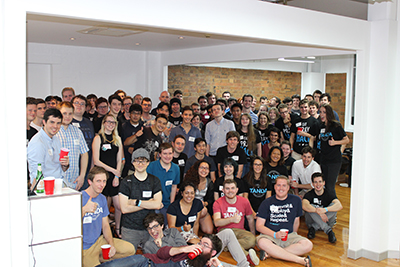
WORKPLACE health and happiness took centre stage at the annual Tanda Hackathon over the ANZAC Day weekend, with 150 of Brisbane’s best programmers creating software that could revolutionise the way we work and live.

The Hackathon was the largest of its kind in Queensland, bringing together information technology (IT) students with industry professionals. 

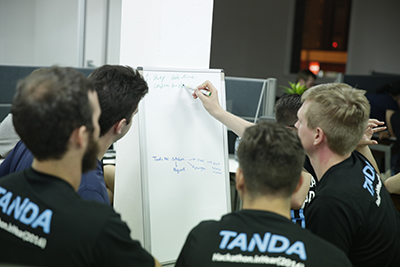
Teams tirelessly worked overnight to create products built from the Tanda application program interfacing (API), with the hope of pitching them to judges Brett Hooker, Adrian Karzon and John Puttick, then prospective customers.

“The event was a huge success. It really goes to show that you only need 24 hours to change the world,” Tanda co-founder Alex Ghiculescu said.

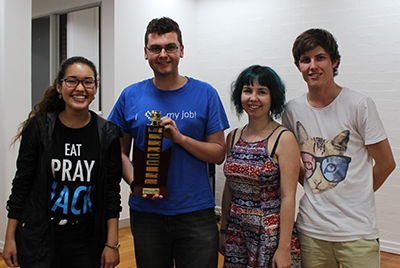
The winning team designed ‘Project 4’, a web app that encouraged employee fitness by linking Fitbit data to Tanda’s rostering platform. Employees are rewarded by how active they are during the shift.

Co-creator of Project 4, Roy Portas said, “We wanted to create something that could combine Tanda’s new API with the Fitbit API to motivate employees at work, but also provide managers with data about their business such as which hours are actually the busiest, based on the movement on employees.

“This was my first Hackathon,” he said. “I’d heard about it through the UQ Computing Society and thought it would a great chance to get in and learn something new. 

“Being a Uni student, I don’t have a lot of time during the week, so being able to come in for the weekend and learn all about APIs in a hands-on environment was fantastic.”

Project 4 wasn’t the only idea focusing on workplace wellbeing, with another team developing an app that used to facial recognition technology to determine employee happiness based on their clock in photos.

Event organiser Nicholas Burge from Tanda said, “It was exciting to see so many people build something really cool. There were so many ideas where you could see that the concept had been really developed and our customers would love to be involved.

“Some other ideas were a little more outrageous, with someone wanting to build a big red ‘I Quit’ button, and another tried to start a Tinder for professionals,” Mr Burge said.

The Tanda Hackathon provides a unique opportunity for programmers to get together and show off their skills while also mingling with fellow developers and IT market leaders, Tanda’s Mr Ghiculescu said.

“Students have limited exposure at university, they were all really appreciative of the opportunity,” Mr Ghiculescu said.

“We’re definitely going to look into doing more networking nights with students.” 

The competition was judged by be judged by Technology One group director of research and development Brett Hooker, Skydive Australia Group technology manager Adrian Karzon, and IT legend John Puttick, the founder of GBST and a QUT Council member. 

Mr Ghiculescu said providing a platform for the “up-and-coming tech legends” has become a core reason for the event, with the lion’s share of every ticket going straight back into university clubs and societies.

Tanda, initially started by four QUT students, is a time and attendance software designed to assist business in increasing their productivity and profitability, by minimising unnecessary wage costs.

Tanda 2016 Hackathon results were:

First place: ‘\lessapprox’ with ‘Project 4’; Roy Portas, Sophia Hooton, Megan Hunter and Jesse Stanger.

Second place: ‘Vansandt’  with ‘Take the Shift’; Scott Barber and Trudi Saul.

Third place: ‘SISO’ with Jeff Lynne, David Buchan-Swanson, Martin Wheeler and Saadit Khan.

http://hack.tanda.co/

www.tanda.co


ends

Tanda calls all ‘hackers, hipsters and IT heroes' for the Hackathon

BRISBANE’s leading programmers, designers and developers will compete at Tanda’s Annual Hackathon next weekend (April 22-23) for the opportunity to market their creations to the world.

The Tanda Hackathon started as a programming competition designed to bring Brisbane’s best programmers and developers together to “create and build something incredible” according to Tanda co-founder Alex Ghiculescu. 

He said the event was all about encouraging innovation and design opportunities for Brisbane’s next generation of tech legends and has quickly grown to be Brisbane’s largest Hackathon. 

“The hackathon is so important, because it provides a chance for students in the programming community to get together and bounce ideas off each other,” Mr Ghiculescu said.

“When I was at uni, there were no opportunities for programmers to get together and practice their ‘art’. The Hackathon offers programmers a chance to get excited about what they do, and to meet others who love it just as much.

“It’s a really fun atmosphere to be part of – you can literally see the sparks flying as people get excited about their ideas.”

Mr Ghiculescu said the Hackathon was a natural extension of the progressive ethos of the Tanda team.

“We started Tanda because the four of us got together and built something cool, but we couldn’t have gotten far without the platform that MYOB and Xero provided for us to build on – that’s what we want to do for others,” he said.

Last year’s winning team, Two Weeks Notice, took out the hotly contested prize after writing an algorithm that could predict with 80 percent accuracy, whether an employee would take a ‘sickie’ in the next fortnight.

Elliott Smith from Two Weeks Notice said, “The Tanda Hackathon was a fun, friendly competition over an interesting dataset. It was great to see all the different solutions that came out of the same set of data. I’m looking forward to defending my title at this year’s event.”

To celebrate the launch of Tanda’s public API, this year’s Hackathon theme is APIs (application program interfaces), which will allow users to build their own apps and businesses around companies like Tanda.

Mr Ghiculescu said the Hackathon was not just “uniting programmers everywhere, but also proving that coding isn’t a boys only club anymore”. The percentage of women attending increased from 5 percent in 2015 to 17 percent in 2016.

Mr Ghiculescu admitted that the event was not just a networking event, but also an opportunity to give back to the university clubs and societies he loved so much at university.

“Forty percent of every ticket sold is going directly back into the University IT and programming clubs and societies – it’s a bit sentimental for me actually,” he said.

“The clubs encourage students to work on their skills but also to be proud and passionate about their area of study- it’s a mission I strongly agree with and I think it’s important to encourage this culture of ideas.”

The competition will be judged by Technology One group director of research and development Brett Hooker, Skydive Australia Group technology manager Adrian Karzon, and IT legend John Puttick, the founder of GBST and a QUT Council member.

Tanda, initially started by four QUT students, is a time and attendance software designed to assist business in increasing their productivity and profitability, by minimising unnecessary wage costs.

http://hack.tanda.co/

www.tanda.co

ends

UniSA brings in global experts for digital learning symposium with experts

EXPERTS in digital learning from across the world are visiting the University of South Australia (UniSA) this week to help outline the evolving role digital learning is playing, from the lecture hall to the modern economy.

Through UniSA’s Digital Learning Week (March 8-18), the visiting scholars will stage keynote addresses, learning cafés, workshops and other opportunities for staff to experiment with emerging learning technologies and to gain a better understanding of the research and innovations that are informing the future of learning in universities such as UniSA. 

UniSA’s Professor Shane Dawson, Professor George Siemens from the University of Texas at Arlington and Professor Dragan Gasevic from the University of Edinburgh have worked to bring the international team of researchers together this week.

With presentations on subjects including technologies to support self-directed learning through social interaction, Big Data, learning analytics and algorithmic accountability, to panel discussions on effective blended/ online teaching, the 10-day long symposium will see multiple events scheduled across all university campuses, with some available via virtual classroom.

A presentation on March 9, Contemplative Practices in Higher Education: The Role of Mindfulness in a Digital Age, will review the theory and research on mindfulness and its relationship with self-regulation and psychological well-being, in the context of teaching and learning and the ways in which technology can both enhance and interfere with these practices.

“The world is digitising and higher education is not immune to this transition, as we are moving from a knowledge revolution to a learning revolution,” Prof. Siemens said.

“The trend is underway and seems to be accelerating, and it is clear that academic organisations are required to facilitate the advancement and adoption of digital learning research.

“Higher education leaders around the world are facing the difficult challenge of re-architecting the university to reflect the modern economy and the digital age. This learning week will enable time to evaluate the scope of changes facing higher education and to explore ways that universities can respond to ensure continued research and education excellence.”

The group of 16 national and international researchers who will be visiting UniSA have extensive expertise in the fields of learning analytics, computer supported collaborative learning, networked learning, artificial intelligence, learning sciences, e-learning, natural language processing and complex systems.

Prof. Dawson said it was the first time the multi-disciplinary group would come together to initiate a roadmap of collective research and innovation as well as aid the promotion and effective adoption of digital learning strategies.

“The digital learning week is one of many new initiatives at UniSA that reflect the University’s commitment to support its staff and students in experimenting and transitioning to new modes of learning and teaching practice,” Prof. Dawson said.

 “The digital learning week provides a unique opportunity for university staff across Adelaide to connect and engage with renowned international and national experts.”

www.unisa.edu.au

ends

Digital Business insights: What we can learn from ants

Digital Business insights by John Sheridan >>

FAMED Professor Michael Porter has highlighted the increasing disconnection between business and society. Companies have become too narrow in their view of economic value creation.

They chase short-term return for shareholders. They enforce price cuts on suppliers. They deskill and automate jobs to reduce wages. They downsize, outsource, relocate and offshore to reduce overheads...all at the expense of the society they operate and live in.

Growth and innovation in business suffers as a result. And business then becomes a major cause of social, environmental and economic problems. 

The disconnection between business and society has created the 1%.

And the disconnection has happened right in the middle of a new digital revolution that is steadily and stealthily connecting everybody up, fostering and encouraging ever more connection and collaboration.

So we witness board and management disconnection at a time of universal interconnection, two societal forces pushing in opposite directions. But only one of them is irresistible.

Google has provided universal, swift and easy access to information, shifting the power from vendor to customer, from the big to the small, from the selfish to the sharing, from the secretive to the transparent.

Businesses need to review and revaluate their narrow views, and endeavour to create economic value by creating societal value – recognising that what is good for the community is good for business. And this even includes banks.

As Michael Porter points out, all profit is not equal. Profit involving shared value helps society to advance more rapidly and allows companies to grow faster.

Business is not just about shareholder value, it is about the sustainability of shareholder value.

Farming value, not mining value. Focusing on the medium and longer-term, not short term.

Most farmers have always understood this. Value adding. Conserving, collaborating, investing and improving, applying a sustainable approach to agriculture that can be passed onto future generations.

The digital revolution pushes issues of economic value and societal value to the forefront. Into the cold light of day and the public domain.

In a revolution where the currents of change drive us towards more connection, more collaboration and more integration, our attitudes inevitably follow.

There is a slow but steady shift in attitude. Not yet for everybody, but apparent in those early adopters of digital technology, the innovators and the young digital natives.

This 20% of organisations - the agile, the smart, the informed and the adaptable – recognise opportunity when it stares them in the face.

The other 80% actually have no choice in the matter, but have failed to recognise that fact...so far. The digital currents of transformation carry them in one direction only.

Out into the digital ocean of change. They are caught in an enormous digital riptide carrying them out to sea faster than they can possibly swim in the other direction, back to the safe, solid land of the 20th century, when direction was clear, plans could be made and followed through, KPIs measured and MBAs meant something.

There is no solid land in the digital revolution. We are all at sea.

That is the intriguing thing about this revolution. We are impacted and affected no matter what we do.

The only intelligent option is to use the currents of change for personal, collective and collaborative advantage. And that means understanding what is happening. "Getting it". Making and taking time to really understand the options and opportunities, not abdicate responsibility to somebody else.

The digital revolution isn't about the froth and bubble of social media and websites. It is about the deep currents of digital disruption – more connection, more collaboration and more integration transforming the world we live in. These currents are changing all aspects of our society forever.

The major barriers and blockages to the digital revolution are nearly all human, nearly all attitudinal and therefore hard to modify and change.

Command and control is redundant. But countless managers wrestle with this new fact every day. Unsuccessfully.

Business loyalty has become hollow. Loyalty now only follows authenticity.

And millions of CEOs still face this disruptive revolution without full comprehension, unwilling to make time to understand what and why and how. "I'm too busy", they say, from the bus as it disappears over the cliff.

People are the barriers and inhibitors. As well as the innovators and inventors.

But revolutions take time. And patience is required.

You can't whip a tree and make it grow. The early adopters will adopt. But then...

For the 80% of slow followers, laggards and digital dinosaurs, a variety of approaches must be taken to explain, inform, cajole, educate, support and continue to support. And different messages are required for different groups of people.

But the decision to engage, the recognition and the understanding of opportunity and threat remains firmly in the hands of the CEO, the Mayor, the Chair and the politician.

These are the people that have to understand how wide ranging, deep and demanding this revolution really is. Most need help. Most are in key roles in our society. Embarrassed. Unwilling to admit to lack of understanding.

And they don't understand what they don't understand, and don't know what they don't know.

These "leaders" in name only are scattered across our nation - all in senior roles, in business, politics, media, government and not-for-profit organisations, all of them holding productive change back.

King Canutes. Millions of them.

This revolution involves technology (tools) AND people (users).

Technology is an enabler. But it has to be coupled with comprehensive understanding, imagination and enterprise.

And the process of change management is not like architecture where we draw a plan, then assemble inorganic elements into a structure. The digital revolution demands an approach more akin to gardening where we never really know what is going to "come up".

We have a general idea of what might be but then have to work with the reality as it emerges. Then water, fertilise, prune.

This is uncomfortable for those who think everything can be controlled. Gardening is intelligent management...not control.

The technology is the "easy" bit. But people are hard.

So all our "we will gain some real societal benefits out of this revolution" endeavours have to recognise the human component.

Software companies understand this. Systems integrators understand this. Education, explanation, training and support have to be ubiquitous.

We can't take this for granted.

Worse still (or better still), we are now entering a stage of connecting organisations, regions, states, countries, supply chains and ecosystems and that requires even more understanding and a very different collaborative approach that is inclusive and recognises the new currency of authenticity, honesty, consistency and trust.

And the traditional brokers are broken.

Industry associations, councils, governments have to seriously consider what it means to collaborate with others, and to move beyond merely talking about it, into action...because most current actions are reinforcing the status quo. Reinforcing the borders, the boundaries, protecting "their' constituents and members (Not for the good of their constituents but for their own vested interests).

Talking about collaboration and working together, and doing it are different things. There are lots of words and discussions...but little action.

This is the next "bump in the road". Get this right and there can be profound benefits in our societies. We will get there, no doubt of that, but governments and industry brokers seem to be largely stuck in 20th century architectural thinking and strategies, when landscape gardener thinking is required. Stuck in command and control when shared value is the new mantra.

Revolutions take time. And it is not easy readjusting views and viewpoints.

It seems to be especially hard for politicians and business groups and industry associations. The polarisation of all viewpoints into left and right, liberal and conservative doesn't ring true in a connected world. There are good ideas from both side and all sides. We need the best of both.

It is no longer about where the idea came from. Who cares? The issue now becomes "Is it a good idea?" measured against all the wicked problems we face as a society.

It is not about point scoring it is only about outcomes.

This is a hard new world for political parties to engage with. For them it is all about the tennis match – hitting the ball back and forth, one side to the other. They can't see how they can be both sides of the net at the same time. Yet, to deal with the wicked problems in society they must be.

It is the same thing with the way we historically organised our businesses and governments into departments to optimise the outputs of the industrial revolution.

The digital revolution demands a different structure. The wicked problems in society can only be solved by cross-departmental collaboration. The game has changed. Competition has morphed into coopetition, into shared value, into collaboration.

Most politicians have long forgotten what the idea of "public service" is about. Not all. But most. And the public has moved on. Power has shifted to the individual. And the individual's networks. "Authenticity rules. OK".

Attitudes that align with the new connected reality resonate. Others don't.

And of course, the digital revolution disrupts politics across the spectrum no matter what political persuasion or views one might have.

The digital revolution provides platforms for discussion outside of the traditional channels and supports initiatives of all kinds. Most politicians are not comfortable with this new disrupted, multimedia environment.

Their power is diminished. Control of the conversation has shifted. It is no longer enough just to be endorsed by Mr Murdoch.

And voters are far less amenable to nonsense and more amenable to common sense and authenticity, and that can come from anywhere, any side of politics, lower house or upper house.

That's why it is called "common" sense. Common sense was uncommon for quite some time but it's steadily creeping back into favour.

The digital revolution endorses the power and straight talking of the independents - the politicians who say what they really think. Because authenticity resonates with the digitally literate.

These are interesting times.

Farmers have to take a long-term view. Miners have a shorter-term point of view. We are witnessing the conflict of these perspectives on the Liverpool plains, and the jury is still out on the final verdict.

Miners can be collaborative. But they are not naturally sympathetic to the operational environment in the way farmers have always been.

Companies working collaboratively can create major improvements in the local business environment. This further reinforces and strengthens the link between an individual company's success and the community's success.

And the positive impacts that innovative businesses achieve locally can be surprising.

A NESTA report from 2009 offers some interesting insights. High growth companies represent roughly 5% of the business population but generate 50% of the new jobs. High growth companies are roughly half high-tech companies and half low-tech. The majority are at least 5 years old. These companies are disproportionately innovative and the innovation appears to cause growth.

Innovative companies grow twice as fast (in employment and in sales).

High growth companies also affect the surrounding business environment – a 5% rise in employment from high growth firms leads to a 1% increase in the surrounding region.

This is exciting. It is a network effect. And a network effect that we can leverage and implement.

A strong community or region, with capable local suppliers, organisations and institutions improves company productivity. There is greater supply chain efficiency, lower environmental impact and greater access to skills.

Companies working collaboratively can create major improvements in the local business environment. This further strengthens the link between an individual company's success and the community's success.

Opportunities to create shared value are tied closely to each company's particular business capabilities and vision. Where are the gaps? How can we fill them? We need to use the tools of the digital revolution to support collaboration and networks to build regional capacity and resources.

The first step is to help individual organisations become more productive and efficient through the optimal use of information and communication technology. Businesses can't move to the next level until they are skilled, confident and aware of the potentials and possibilities on offer – ready, willing and able.

Professor Porter suggests that businesses should incorporate a social dimension to their value proposition, to make them more sustainable versus competitors.

This will in turn help transform thinking and practice about the role of the business in society, giving rise to far broader approaches to creating value and leading to innovation, increased productivity and growth.

CEOs need to start thinking about what they do within the context of the whole region. Business isn't just about business. It is about every aspect of the society a business operates in.

The three underlying currents of the digital revolution – more connection, more collaboration and more integration provide the "climate conditions" for success.

Connection allows easy and swift access to information and knowledge.
Collaboration tools allow issues to be productively and collectively addressed. We need to build on the emerging toolkit of Linkedin, Twitter, Facebook, YouTube, email newsletters and other tools to generate regional shared value and take collaboration to the next level.

The key is always relevance. Novelty is enough to attract users but relevance is the glue that binds them.

Whose responsibility is it to think and act like this? Well, it should be the responsibility of central government, but we all know how much government suffers from the very factors Professor Porter outlined – short termism, polls and popularity, departments and departmental thinking.

So we need to drop down a level to the councils and regions that are already thinking and operating holistically anyway. When you directly engage with your "end user" every day, you have to take them seriously.

That means making connected decisions on regional strategic opportunity eg tourism attraction, job creation, startup support, training, food security, carbon reduction, ageing, collaboration etc.

That means working with councils next door. That means looking at the greater good of the region not thinking solely about what happens within the council borders.

And that needs Mayors to sit down and discuss common issues and collaboration. And make decisions. And test those decisions in the regions at the grass roots, where the feedback is meaningful.

Who will make these decisions? Politicians? Possibly. Hopefully.

But it seems to be more likely that those decisions will be made in a piecemeal manner by a wide range of individuals, organisations and businesses. That is not necessarily a problem if the pieces can connect up productively to create new collaborative, fertile territory for positive change.

Ants operate collaboratively for the good of the nest. The queen does not control what happens in the nest. She lays the eggs. She creates the resource.

The ants forage, find food and manage threats with all the "decisions" being made at the small group level. The ants collaborate to solve problems. There is no central command and control. Yet the result of collaboration at this level is remarkably successful.

Collaboration at grass roots is already happening, not just in Australia but across the planet. It is a very natural activity. Individuals and groups are collaborating to solve problems. Now we just need to scale up. And take this collaborative approach to the next level.

We can learn a lot from ants. They are successful. They have collaborated for 100 million years. And if the humble ant can manage this so successfully, surely we can.


John Sheridan is CEO of Digital Business insights, an organisation based in Brisbane, Australia, which focuses on helping businesses and communities adapt to, and flourish in, the new digital world. He is the author of Connecting the Dots and getting more out of the digital revolution. Digital Business insights has been researching and analysing the digital revolution for more than 15 years and has surveyed more than 50,000 businesses, conducting in-depth case study analysis on more than 350 organisations and digital entrepreneurs.

http://www.db-insights.com/

ends